
In this tutorial we will demonstrate the calculation of density for solid bodies like a wooden rectangular block, a metal cylinder or an irregular shaped object.
Equipment
- Electronic balance PCB1001.19
- Metal cylinders of equal weight PS2021.22
- Wooden blocks PS2021.11
- Glass beaker 400ml PS2030.5
- Ruler PS2021.18
- Plastic cylinder 100ml CT3001.18
Materials
- Plasticine
Resourses

Safety Note
There are no special safety requirements for this experiment.
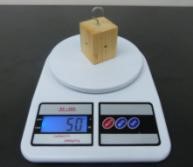
- Weight the wooden blocks and record their mass m.
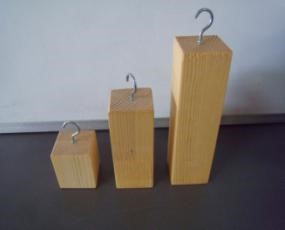
Based on your experience which of the three wooden block has the bigger volume?
- Calculate the volume V of the wooden blocks.
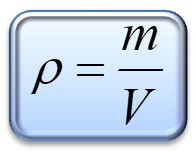
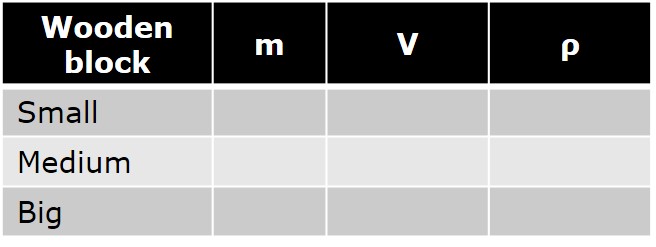
- As you already know the mass and the weight of the blocks now calculate the density and fill in the data table.
- Weight the mass m of each metal cylinder and by measuring their dimensions calculate their volume.
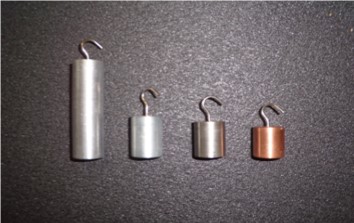
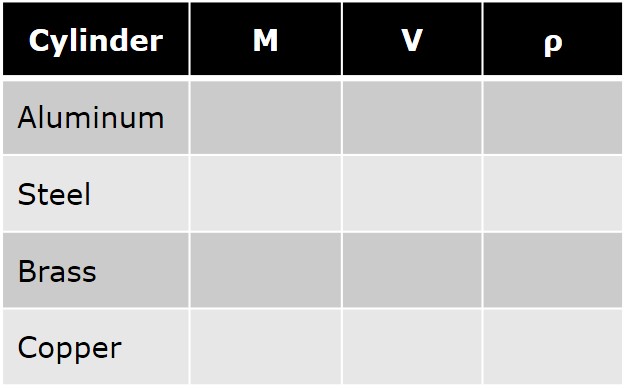
- As previous calculate the density of each cylinder and fill in the data table.
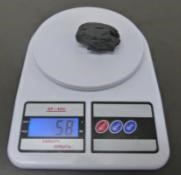
- Take a piece of plasticine with no normal shape. Weight its mass.
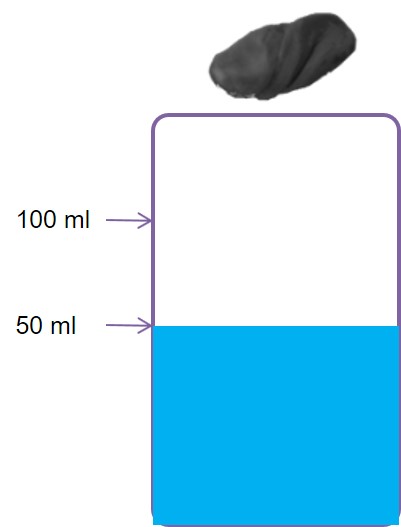
- Pour water into the plastic cylinder, record the water lever. Immerse the plasticine piece into the water and record the new water level. The volume of the displaced water is equal to the volume of the plasticine piece.
- Now you can calculate the density of plasticine.
Conclusion
- Each material regardless of the shape or size will always have the same density, since the density expresses how much mass is contained in a particular volume. This fact is verified in the experimental procedure of wooden objects.
- Correspondingly for different type of materials, ie different density such as metal cylinders, we found that despite having the same mass they take up different volumes.
- Finally, the most complete experimental method used to determine the volume is the method of the displaced water since it does not require the use of geometrical formulas nor the geometric symmetry of the sample.
Question 1
Which of the following properties is fundamental?
- force.
- mass.
- acceleration of gravity.
Question 2
Which of the following properties is derivative?
- mass.
- length.
- weight.
Question 3
Which of the following units is fundamental?
- kilograms Kg.
- grams g.
- Newton N.
Question 4
The mass is affected by:
- The shape of the object
- The color of the object
- The volume of the object
- None of the above
Question 5
If the density of water is 1g/cm3 and the density of ice is 0,92g/cm3, which has more volume, 1kg of water or 1kg of ice?
- Ice.
- Water.
- They have the same volume.
Question 6
Two solid objects A and B have densities ρΑ>ρΒ and the same mass. So:
- VA > VB
- VA < VB
- VA = VB
Question 7
A piece of cork is cut into two equal pieces. The density of each piece is:
- the same with the initial piece.
- twice the density of the initial piece.
- the half of the density of the initial piece.
End of tutorial