
Experiment Setup
Equipment
- PS2030.27 Metal base
- PS2030.28 Metal support rod
- PS2030.29 Boss
- PS2030.30 Metal rod with metal clamp
- PT2011.6 Weight set A
- PS2021.17 Retractable ruler
- RS108 Photogate sensor
- PS2021.6 Data logger DL100
- String 50 cm
Software
- ilab Windows Application
Schematics

Safety Notes
There are no special safety requirements for this experiment.
Make sure the bob can oscillate without getting in contact with the photo gate sensor.
For the proper usage of the sensor please read the instruction manual before using it.
1. Construct the pendulum of the following picture by assembling the retort stand and suspend a 50g weight as a pendulum bob by a string from the metal rod.

2. Adjust the height of the rod to allow you to set the length of the string 40 cm. The pendulum bob must be able to oscillate freely at it’s trajectory, so it can pass through the photo gate without hitting it.

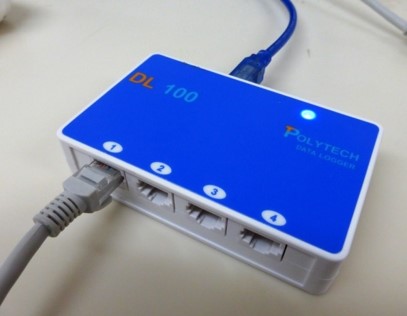
3. Connect the data logger DL 100 with the computer via USB cable. Afterwards connect the photo gate sensor with the data logger via UTP cable.
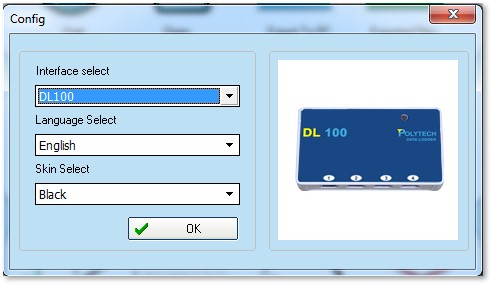
4. Run the ilab software and at the main menu click the “setup” button.

Make sure that DL 100 is selected.
5. At the main menu click “New Experiment” button to be forwarded to the experiment screen.

6. At the experiment screen you can locate the following operating areas:
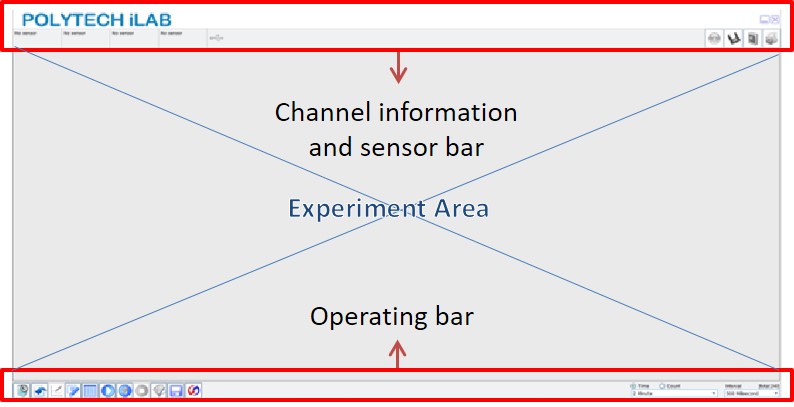
Effect: If the lamp turns on, then your circuit is successfully connected.
7. At the operating bar click “Rapid Experiment (F1)” button…

and at the channel information bar click “Photogate setup” button in order to set up the photo gate.

8. At the emerging window select the following:
- Experiment type: Simple pendulum
- Method of measurement: Independent measurement
Then click “next”

At the presented options:

- Quantities to be measured:
check “Frequency” and “Period”
Then click “next” and “finish”.
Note: If it is appropriate you can also select kinetic energy as our set-up can support it.
9. At the operating bar set the login time to 20 seconds and the interval to 10 millisecond.

10. Whenever you want to start collecting data, by clicking “Start (F6)” button the measurements will be shown on your graph screen.

Note: Other students can also use a stopwatch at the same time when collecting data to count 10 oscillations so the concept of period can understood in depth.
An oscillation takes place when the bob passes through the equilibrium position twice and end up at the position where the oscillation started. The position where we let the bob oscillate does not count.
11. Move the bob 5 cm away from equilibrium (this will be the amplitude of oscillation) and let it execute 10 oscillations.

12. Start collecting data with the ilab software, what can you conclude about the period and frequency?

13. Repeat the experiment for amplitudes of 7.5 and 10 cm in order to populate the following table. Which changes do you observe?

14. Repeat steps 11 to 13 by using as a bob an 100 g weight. Populate the following table, which changes do you observe?
The period and the frequency of the pendulum is independent of the amplitude of the oscillation as long as the deviation angle of the string is small.
It is important to notice from our measurements that the mass of the bob does not influence the period and the frequency of the pendulum.
15. Lets find out if the length of the string can influence the oscillation. Repeat the experiment by adjusting the length of the string at 30 and 20 cm in order to populate the following table.


16. Based on the data of the table for the length of sting L and the period T, calculate T2 for each instance and draw the L – T2 graph.

What do you conclude about the relationship between length of the string and the period of the pendulum?
The period of the pendulum is clearly influenced from the length of the string.
It is proven that the period of a simple pendulum when the amplitude of the oscillation is relatively small, it is expressed from the equation:

Question 1
The oscillation period of a pendulum depends on:
- the amplitude of the oscillation
- the mass of the object
- the length of the thread
- the density of the object
Question 2
Time equal to a period passes from the moment that a body that oscillates is located:
- at a maximum amplitude until it reaches to the other side
- at a maximum amplitude until it returns to the same position
- in a random position until it returns to the same position
- in a random position until it returns to the same position moving with the same direction
Question 3
A material point performs 20 full oscillations around the equilibrium position in 5 seconds. The period of oscillation is:
- 5 sec
- 4 sec
- 0.25 sec
Question 4
If we transfer a pendulum from equator to the poles of the Earth will occur no change in the period of oscillation.
- True
- False
Question 5
During an oscillation occurs periodically conversion of (a)________ energy into (b)________ and vice versa.
- (a) dynamic, (b) kinetic
- (a) kinetic, (b) mechanic
- (a) dynamic, (b) mechanic