
In this tutorial we apply Archimedes principle to calculate fluid’s density using a force sensor, a data logger a metal weight.
Equipment
- Metal base & PCB1001.1
- Metal support rod PCB1001.2
- Boss PCB1001.3
- Metal rod with metal clamp PCB1001.4
- String PS2021.6
- Weight 100g PT2011.6
- Archimedes demo set PT2010.6
- Force Sensor RS106
- Data logger DL120RS
- Windows PC with iLab software

Important Safety Note
No personal safety requirements for this experiment.
For the proper usage of the sensor please read the instruction manual before it. using
- Assemble the metal base and metal support rod and fix the metal rod with metal clamp at 25 – 30 cm height from the base.

- Screw the force sensor from the metal rod with metal clamp The force sensor must have its hook downwards as in picture.

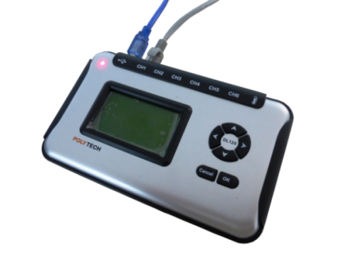
- Connect the datalogger DL120RS with the PC via usb and the force sensor with the datalogger via UTP cable at port #1.
- a. Download, unzip and open the experiment to iLab PC software directly. Click Continue to advance to step 12.
– OR –
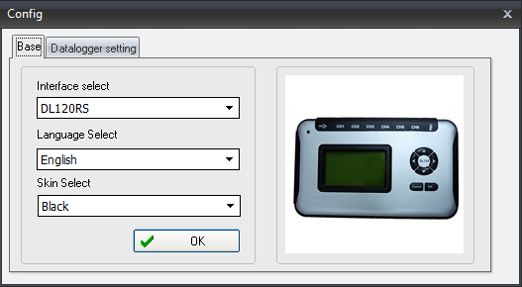
4.b. Run the iLab software and in the main menu select «Setup». (Click to expand)

Make sure that the “DL120RS” option is selected
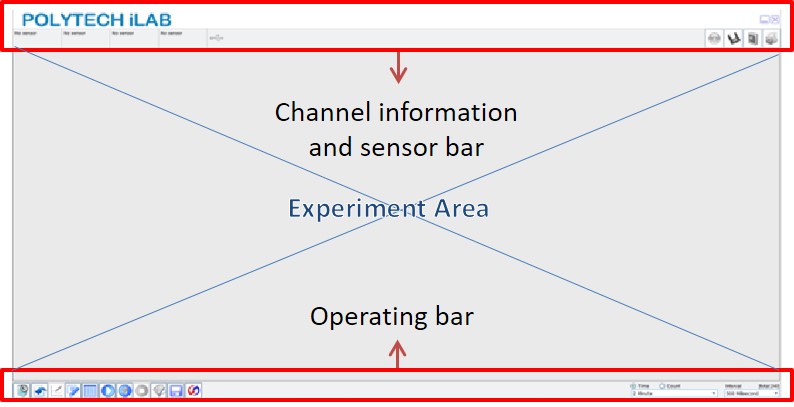
- In the main menu select “Start“ and the experiment screen will open automatically.

In the experiment screen you can see the following functional areas:
- In the operating bar select “New page (F2)”

and choose the digital display option.

By right clicking, choose the force sensor.
- You can adjust the time of the experiment and the recording intervals according to your preferences but also default settings fulfill the requirements of the particular experiment.

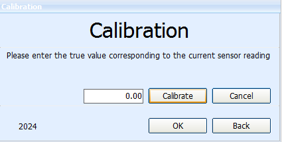
- Force sensor should be calibrated before each experiment. In order to calibrate the sensor click the calibration button on the channel information bar.

- On the calibration screen select the “Channel1: force ”.

On the next screen select the “Zero” button.
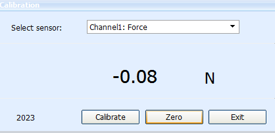
- To the next screen select the “Calibrate” button click ok and you are ready to proceed with the experiment.
- Whenever you are ready select “Start (F6)” to start collecting data.

- By using a cord suspend a 100g weight from the force sensor and note its weight.


- Fill the Archimedes container with water and let it pour from the extension tube until it is stabilized. Position the Archimedes container exactly below the sensor and the enumerated plastic tube under the drainage pipe of the extended tube.

- Lower the hooked weight of 100g from the sensor into the plastic container and record the sensor’s value.


- Record the volume V of the displaced water from the plastic tube
How to measure the fluid’s density
- The formula for the density is: ρ= m/V
- The mass of fluid can be calculated from the buoyant force utilizing Newton’s second law (F=m*a). The buoyant force can be found by subtracting our weight measurements.
Fbuoyant= Win air + (- Wimmersed in water) = 0.98 – 0.85= 0.13N
Fbuoyant = m*g => m = F/g = 0.13/9.8 = 0.013Kg = 13g - The volume of the displaced fluid was found from the conical tube V = 12 ml
- So we’re ready to calculate the fluid’ s density:
ρ = m/V = 13/12 = 1.08 g/ml ≈ 1.1 g/ml

So WATER is the fluid.
You can further experiment on different kind of fluids. (e.g. petroleum, oil etc.)
Question 1
Two compact bodies A and B have densities ρA> ρB and equal masses. Therefore:
- A) VA > VB
- B) VA ˂ VB
- C) VA = VB
Question 2
Which of the following statements is correct?
- A) Unit of buoyancy is 1 Ν
- B) Liquid with highest density exerts a lower buoyant force
- C) The buoyancy is independent of the volume of the body that is submerged in the liquid.
- D) Buoyant force exert on liquids.
Question 3
In a vessel a wooden ball balancing immersed halfway with water. If we add salt in water, then:
- A) The ball will balance submerged again halfway in the water
- B) The ball will balance immersed less in the water
- C) The ball will balance immersed more in the water
- D) The ball will sink and will balance at the bottom of the container
Question 4
When the density of a body is less than the density of the liquid in which it is immersed, then the body:
- A) Sinks in water
- B) Floats on liquid
Question 5
When a body in a immersed in a fluid, the gravitational force that the Earth exerts on it:
- A) Remains the same
- B) Is zeroed
- C) Increases
- D) Decreases
End of tutorial