

Contents
Equipment
- Stopwatch PS2030.6
- Metal base PS2030.27
- Metal support rod PS2030.28
- Boss PS2030.29
- Pendulum device PT2010.9
- Temperature sensor RS104
- Weight set PS2021.7
Access to
- Analog wristwatch

Safety Note
No personal safety requirements for this experiment.
- As in the case of the length, different accuracy is required to calculate the distance between cities and different accuracy to find the thickness of a page, similar situations occur in time measurement. Discuss the accuracy that is required for the measurement of the following times:

- Set the base up and adjust the device of the pendulum at the top using the boss, as shown in the photo. Use a long metal support rod to create a long pendulum and place a weight at the edge.

- The upper right button “start/stop” stops and initiates the timing.
- When the timer is stopped the upper left button resets the timer.


- Fill in the table below with the results of the measurements made in step 4 and calculate the average (mean) in each case.

- If differences observed between the values of each column, why do you think that happen? Is the Average affected by the accuracy of measurements?

- Assuming that the analog and digital clocks, that we used, operate properly, the differences must be due to how each student responds in time when switching on and off the timer. The Average measurement differs too, with greater precision closer to the “real” value.
- Nowadays, the development of technology allows the manufacture of timers which have the ability to measure billionths or even trillionths of a second. The operation of these individual timers is based on a simple physical principle, the natural frequency of atoms.
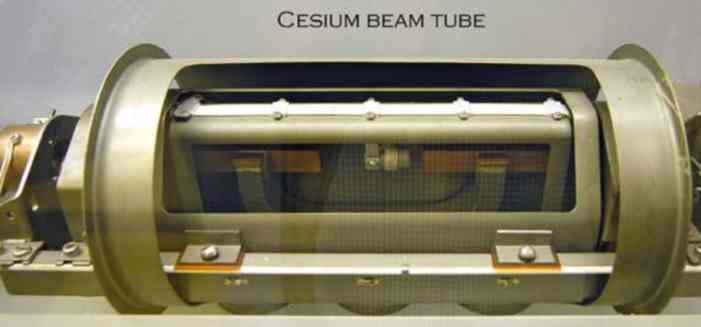
Atoms and molecules emit and absorb electromagnetic radiation at a series of fixed frequencies that depend on their structure. The frequency of the radiation is measured in Hertz. Clocks are mainly composed of two parts: a) the production system of a stable atomic frequency standard, and b) an electronic device to measure the respective oscillations.
Question 1
The hourglass is a measuring instrument of…
- Length
- Time
- Mass
- Temperature
- Speed
Question 2
At multiple time measurements of a phenomenon we should use:
- The same instrument and different conditions
- Different instruments and different conditions
- The same instrument and same conditions
- Different instruments and same conditions
Question 3
The time measurement (time interval) can be done
- with a measuring tape
- with a balance
- based on certain physical phenomena
- with a speedometer
Question 4
If Kostas travels at a slower speed than we do towards a destination
- it will take him less time than us to reach the destination
- it will take the same time for all of us to reach the destination
- he travels a shorter distance per second.
- it will take him more time than us to reach the destination
End of tutorial